You get a really great picture in today's blog, by photographer Roeloff Bakker, whose images of the abandoned Hornsey Town Hall won a London Photographic Association first prize earlier this year http://www.rbakker.com/still/.
It's here because I'm posting to celebrate having just finished a short story inspired by another of his photos.
I've found that it's really hard to write a story to accompany someone else's work - though I love Roeloff's pictures, and found them moving and thought provoking, the thoughts they provoked didn't seem to lead to stories that worked with the photo I'd chosen. How far can you move from the picture? And how much can you say in no more than 1500 words?
I put my first feelings on seeing my chosen picture aside as unworkable in story form, and for several weeks have been wresting with other ideas which just didn't seem to grab my attention. Enough, I said to myself yesterday, and sat down and wrote two-thirds of a story. Today I threw it away and in an hour wrote something completely new, which went right back to my first gut reaction on seeing the picture. I've no idea if it works - my (not famously literary) son says it's mad but great and he's looking forward to having a mum who's famous for writing mad but great stories. Me too. But maybe it's mad but terrible. I'll put it aside and re-read in a few days.
If you like Roeloff's photos of abandonment, take a look at these, of the terrible destroyed centre of Detroit, by Yves marchand and Romain Meffre http://www.marchandmeffre.com/detroit/index.html . I'm saving up for the book.
Thursday, 21 July 2011
Wednesday, 13 July 2011
Lounging with Trollope
I've been off the blog radar for the last couple of weeks, doing this and that, interviews for a lovely piece of journalism, a bit of admin, a lot of desperate weeding in the veg plot, heaps of reading (just re-read JG Ballard's Concrete Island to see why I loved it when I was 15, and remembered how shocking and spare it is) ...
... and I nipped up to London a couple of weeks ago, to hear a whole bunch of Bloodaxe poets read (highlights were Susan Wicks and Carole Satyamurti, who were the reason for me trekking from Sussex to Shoreditch, and Kona Macphee, who made a surprise guest appearance, and who was wonderful - she won the Geoffrey Faber memorial prize last year, and I can see why). I'm a poetry slacker - I read in bursts, and then not at all for ages - but whenever I pick up a book of poems that work for me, they remind me of just how powerful language can be, and how dangerous, and how surprising. Poems make me write differently, that's for sure, because they challenge me to move away from the prosaic. Just read Susan Wicks' opening poem from House of Tongues, 'Pistachios' and then try writing a straight piece of prose.
When I left the reading all sorts of new ideas had appeared in my head, and within a couple of days I knew how to write the story that had been swimming around for a couple of weeks getting nowhere. So last week, I delivered it to ... well you'll have to wait and see, but it's coming out in September, I believe. As soon as I know for sure, I'll post the link here and you'll be able to read it.
Within hours of sending off my story, I was at Lounge on the Farm, a smallish festival near Canterbury - I went last year and discovered that being stuck in a field with 10,000 other people is surprisingly relaxing, as long as you admit to not being 16 and pitch your tent in the quiet field. And watch the big acts like Ellie Goulding only for long enough to realise that she's not very interesting so you're better off in a small tent with an unknown act who might be great, and who won't wreck your eardrums, and where you can sit peacefully on a bale of hay while you listen.
Here's the crowd behind me at Ellie Goulding:
And here's the six foot four man with a huge hat in front of me:
I didn't discover any acts that I loved this year, which I guess is a shame - but while listening to a whole load of perfectly good acts I did read the first few chapters of Trollope's Barchester Towers. It's not the ideal book for a festival - all around me people were lazing in the sun in various stages of undress, relaxation and inebriation while the residents of the Cathedral Close in Barchester circled each other and schemed with 19th century courtesy. I'm getting along much better with Trollope now I'm home.
Anyway, I shall continue to listen to First Aid Kit http://thisisfirstaidkit.com/ and Erland and the Carnival http://erlandandthecarnival.com/erland_and_the_carnival.html, whom I loved last year at LOTF, and who sound just as good as they did when I first heard them.
And tomorrow I start a new story ...
... and I nipped up to London a couple of weeks ago, to hear a whole bunch of Bloodaxe poets read (highlights were Susan Wicks and Carole Satyamurti, who were the reason for me trekking from Sussex to Shoreditch, and Kona Macphee, who made a surprise guest appearance, and who was wonderful - she won the Geoffrey Faber memorial prize last year, and I can see why). I'm a poetry slacker - I read in bursts, and then not at all for ages - but whenever I pick up a book of poems that work for me, they remind me of just how powerful language can be, and how dangerous, and how surprising. Poems make me write differently, that's for sure, because they challenge me to move away from the prosaic. Just read Susan Wicks' opening poem from House of Tongues, 'Pistachios' and then try writing a straight piece of prose.
When I left the reading all sorts of new ideas had appeared in my head, and within a couple of days I knew how to write the story that had been swimming around for a couple of weeks getting nowhere. So last week, I delivered it to ... well you'll have to wait and see, but it's coming out in September, I believe. As soon as I know for sure, I'll post the link here and you'll be able to read it.
Within hours of sending off my story, I was at Lounge on the Farm, a smallish festival near Canterbury - I went last year and discovered that being stuck in a field with 10,000 other people is surprisingly relaxing, as long as you admit to not being 16 and pitch your tent in the quiet field. And watch the big acts like Ellie Goulding only for long enough to realise that she's not very interesting so you're better off in a small tent with an unknown act who might be great, and who won't wreck your eardrums, and where you can sit peacefully on a bale of hay while you listen.
Here's the crowd behind me at Ellie Goulding:
And here's the six foot four man with a huge hat in front of me:
I didn't discover any acts that I loved this year, which I guess is a shame - but while listening to a whole load of perfectly good acts I did read the first few chapters of Trollope's Barchester Towers. It's not the ideal book for a festival - all around me people were lazing in the sun in various stages of undress, relaxation and inebriation while the residents of the Cathedral Close in Barchester circled each other and schemed with 19th century courtesy. I'm getting along much better with Trollope now I'm home.
Anyway, I shall continue to listen to First Aid Kit http://thisisfirstaidkit.com/ and Erland and the Carnival http://erlandandthecarnival.com/erland_and_the_carnival.html, whom I loved last year at LOTF, and who sound just as good as they did when I first heard them.
And tomorrow I start a new story ...
Monday, 20 June 2011
Bang, bang, you're dead
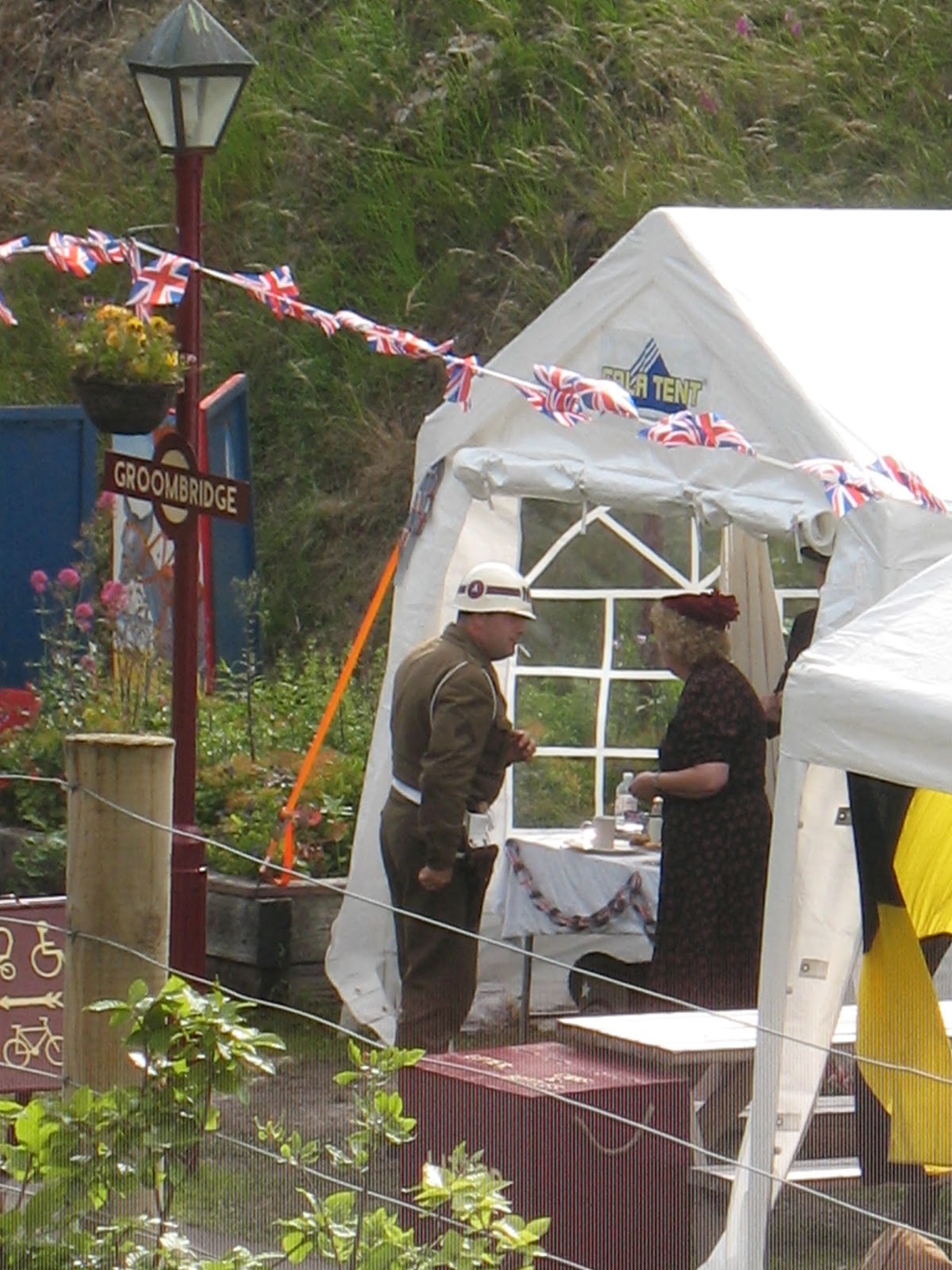
This was the scene from our bedroom window yesterday afternoon on the station platform beside our house. The local steam railway society holds an annual 1940s weekend, by which they actually mean a World War II weekend. It delivers to my windowsill the happy sight of clipped gentlemen in army uniform standing tall beside more relaxed visitors in 21st century leisurewear. And the oddity of people flocking to our quiet village to wallow in nostalgia for a time when we were all full of fear and when people died horribly.
(And sang cheerful songs, and met lovers, and discovered they could do far more than they realised, and developed great friendships, of course. I know all of this. I just find it strange that so many people, for the most part too young to remember the war, like to celebrate it.)
It also gives some very weird people the chance to march up and down the platform wielding a trunchion, presumably in case the dancers get a bit frisky, or someone forgets it's all make-believe and starts actually letting off bombs and firing guns. What he'd do if he met a German, I've no idea. Arrest them for being a spy?
The worst bit for us is that the noise is relentless - jolly music, sirens, explosions, gunshots ... And at lunchtime on Saturday a Lancaster bomber flies past, right over our garden, very low. It happens every year, and every year that low droning engine noise shudders over my head, I'm filled with a visceral terror. I've no idea why - I've never been in a war, so it's not digging up old memories.
It's all gone now, bar the bunting - that'll do for the Summer Evening and Wine Special next weekend.
(And sang cheerful songs, and met lovers, and discovered they could do far more than they realised, and developed great friendships, of course. I know all of this. I just find it strange that so many people, for the most part too young to remember the war, like to celebrate it.)
It also gives some very weird people the chance to march up and down the platform wielding a trunchion, presumably in case the dancers get a bit frisky, or someone forgets it's all make-believe and starts actually letting off bombs and firing guns. What he'd do if he met a German, I've no idea. Arrest them for being a spy?
The worst bit for us is that the noise is relentless - jolly music, sirens, explosions, gunshots ... And at lunchtime on Saturday a Lancaster bomber flies past, right over our garden, very low. It happens every year, and every year that low droning engine noise shudders over my head, I'm filled with a visceral terror. I've no idea why - I've never been in a war, so it's not digging up old memories.
It's all gone now, bar the bunting - that'll do for the Summer Evening and Wine Special next weekend.
Tuesday, 14 June 2011
Paper, I love you
Can you write on it? my son said when I showed him the paper I made. And I was briefly crestfallen - after all, what's the purpose of paper on which you cannot make a mark? Or at least, if you make a mark, it will soak in, be rendered illegible. What is paper for?
As a reader, writer and editor of a certain age, paper is at the core of my life. I've been surrounded by books for as long as I can remember. The first job I loved was in a book publisher's - and real and important part of the joy of that work was that at the end of a long process of thinking of things people might want to read about, finding authors, working beside them on their scripts, editing them, designing the pages, choosing cover artwork, selling the idea to the sales teams, at the end of all that, a box would arrive on my desk with a pile of brand new books. Real, solid objects which together we had created, and which we hoped to send out into the world for thousands of people to read. And those books were made of paper.
I know that e-books are wonderful. I've downloaded a couple myself (Mary Kingsley's Travels in West Africa being the most recent - sadly not available in my county library). But they don't have the feel of a book.
Books, and paper, have heft. They have physical character. A long one weighs heavy in your hand. Pulp fiction is, well, pulpy. Leave it out in the rain and it dissolves. Even when disposable, they're something.
And beautiful paper is something else again. My first ever business cards (long, long ago) were hand printed, letter press, on gorgeous laid card. I almost couldn't bear to give them away. Each letter sank into the card, floated on the waves of its gently rippling surface. They were objects of beauty. And not very useful, as I spent those early freelance years huddled at my desk, not out and about meeting future clients.
Anyway, this weekend I went up to Birmingham, to a conference of intervenors - people who work one-to-one with congenitally deafblind children and adults, enabling them to take part in the world. They're a real pleasure to spend time with - you probably couldn't find a more communicative, caring and varied bunch in any other church hall in the country. And we had great fun (and made a great mess) making paper - a perfect activity to do with pretty much anyone, including the people they support.
The idea wasn't to make paper that has a function, but simply to see what happens when you make the basics of paper from recycled office shreddings, and add anything that comes to hand. In my case, bits of grass and petals from the space outside the hall - but you can mix in seeds (which will grown if you plant the paper), glitter, feathers, spices ...
I can't say that my paper was exactly an object of beauty, but I love the way that letters from the old shreddings peep out, and that grass stems are enveloped in the pulp, which just sometimes reveals its own origins in its fibres.
My piece about intervenors will be in the next issue of Talking Sense, due out in about a month. It's published by Sense, the deafblind charity. http://www.sense.org.uk/
Monday, 6 June 2011
Don't worry, Mum
My Mum rang today and amongst other things we talked about her re-reading of The Bell Jar in preparation for teaching it . 'I feel sorry for her mother', says my Mum. I reassure her that I'll never write such a book. And we fall to wondering if great writers are always pretty unpleasant or difficult to live with - do you have to be self-centred, self-obsessed and put your writing first in order to produce great work? We can list plenty of great writers who'd have been hell to live with - Tolstoy, Dickens, Joyce, Woolf and Yeats popped up straight away - but who are the great but kind writers? They must exist, surely? George Eliot sounds pretty much OK to me. Who else? (Notice I'm not mentioning living writers as I've no intention of guessing which are decent people to know and which aren't - I'll wait for the safe distance of history.)
Unoriginally, I suggested that producing really great work means putting the work first. Screaming children, sad spouses, no food on the table - nothing matters if you've got words in your head that you absolutely have to get down on paper.
That counts me out - I long ago accepted that screaming children came first. Spouses can be allowed to be sad for a short while - but not indefinitely - and I've always put dinner on the table, no matter what. And done the odd bit of cleaning, and quite a lot of work that helps pay bills.
As a younger writer I was inhibited by the fact that I'm not willing to write about my family, even in code (broke that one today, I guess) - it seemed to block off pretty much everything I was inspired to write about. A writing tutor told me that to be a writer you have to be able to write about whatever grabs you - you can't turn away if it's what you need to tell. And if what you need to say will hurt people close to you, then that's part of being a writer.
I stopped writing for quite a while after that.
My Mum reckons that my priorities mean I'll never be great writer. Thanks Mum! But she's probably right. I've had a novel swilling around in my head for several years now, but I know that writing it would wreck our family life - my head would be in the book, not with what's happening in the real world around me. So it's staying there in my head until I've fewer responsibilities. (Or maybe I'm the big-head and the world can get along just fine without me.)
In the meantime, short stories are perfect - ridiculously challenging, satisfying when everything comes out right after the struggle, and conveniently writeable in a week in the gaps between all the other things I have to do ... And the more I write them the more I come to love them as a form, and to realise that if one day I've produced a great body of short stories I'll be happy even if I never write the novel. It might take a while, that's all.
Unoriginally, I suggested that producing really great work means putting the work first. Screaming children, sad spouses, no food on the table - nothing matters if you've got words in your head that you absolutely have to get down on paper.
That counts me out - I long ago accepted that screaming children came first. Spouses can be allowed to be sad for a short while - but not indefinitely - and I've always put dinner on the table, no matter what. And done the odd bit of cleaning, and quite a lot of work that helps pay bills.
As a younger writer I was inhibited by the fact that I'm not willing to write about my family, even in code (broke that one today, I guess) - it seemed to block off pretty much everything I was inspired to write about. A writing tutor told me that to be a writer you have to be able to write about whatever grabs you - you can't turn away if it's what you need to tell. And if what you need to say will hurt people close to you, then that's part of being a writer.
I stopped writing for quite a while after that.
My Mum reckons that my priorities mean I'll never be great writer. Thanks Mum! But she's probably right. I've had a novel swilling around in my head for several years now, but I know that writing it would wreck our family life - my head would be in the book, not with what's happening in the real world around me. So it's staying there in my head until I've fewer responsibilities. (Or maybe I'm the big-head and the world can get along just fine without me.)
In the meantime, short stories are perfect - ridiculously challenging, satisfying when everything comes out right after the struggle, and conveniently writeable in a week in the gaps between all the other things I have to do ... And the more I write them the more I come to love them as a form, and to realise that if one day I've produced a great body of short stories I'll be happy even if I never write the novel. It might take a while, that's all.
Wednesday, 1 June 2011
The divine drink
Here's my drug of choice - a small chunk of Divine 75% chocolate to be taken daily with my morning coffee.
Montezuma rated it pretty highly too - back in the sixteenth century he said:
Me and Montezuma aren't alone in our love of good chocolate, so some splendid scientists at the University of Hull decided to see if it (ie the beautiful stuff that's gots lots of cocoa in it - and therefore lots of polyphenols) helps the symptom of fatigue in people with ME.
And guess what, it does - really significantly. Hurrah! And even though their test subjects ate 15g of 85% chocolate three times a day for eight weeks, they didn't gain weight - they just felt loads better. And as soon as they stopped and ate pretend chocolate (prepared specially by Nestle), the fatigue returned.
So even though the ME that buggered up my life for fifteen years or so is well in abeyance, I reckon I should keep on eating top quality chocolate every day - and maybe even several times a day is it seems to me that I may not be consuming a high enough dose at the moment. I'm not complaining.
Here's the full paper (in Nutrition Journal): http://www.nutritionj.com/content/9/1/55 It's called 'High cocoa polyphenol rich chocolate may reduce the burden of the symptoms in chronic fatigue syndrome' and it's by
Thozhukat Sathyapalan, Stephen Beckett, Alan S Rigby, Duane D Mellor and Stephen L Atkin. Hope they get a lifetime supply of gorgeous chocolate as a reward!
Oh, and I got better from ME after following the Gupta Amydala Retraining Technique - six months of meditation, NLP and visualisations. ME is a neurological disease - it's not all in the mind - but you can switch off the triggers with these techniques http://www.cfsrecovery.com/
Montezuma rated it pretty highly too - back in the sixteenth century he said:
"The divine drink, which builds up resistance and fights fatigue. A cup of this precious drink [cocoa] permits man to walk for a whole day without food"
Me and Montezuma aren't alone in our love of good chocolate, so some splendid scientists at the University of Hull decided to see if it (ie the beautiful stuff that's gots lots of cocoa in it - and therefore lots of polyphenols) helps the symptom of fatigue in people with ME.
And guess what, it does - really significantly. Hurrah! And even though their test subjects ate 15g of 85% chocolate three times a day for eight weeks, they didn't gain weight - they just felt loads better. And as soon as they stopped and ate pretend chocolate (prepared specially by Nestle), the fatigue returned.
So even though the ME that buggered up my life for fifteen years or so is well in abeyance, I reckon I should keep on eating top quality chocolate every day - and maybe even several times a day is it seems to me that I may not be consuming a high enough dose at the moment. I'm not complaining.
Here's the full paper (in Nutrition Journal): http://www.nutritionj.com/content/9/1/55 It's called 'High cocoa polyphenol rich chocolate may reduce the burden of the symptoms in chronic fatigue syndrome' and it's by
Thozhukat Sathyapalan, Stephen Beckett, Alan S Rigby, Duane D Mellor and Stephen L Atkin. Hope they get a lifetime supply of gorgeous chocolate as a reward!
Oh, and I got better from ME after following the Gupta Amydala Retraining Technique - six months of meditation, NLP and visualisations. ME is a neurological disease - it's not all in the mind - but you can switch off the triggers with these techniques http://www.cfsrecovery.com/
Monday, 23 May 2011
Robin Robertson top of the pops
Way back in January I posted about hearing Robin Robertson read on the radio. To my pleasure, when I was driving home yesterday, I heard him read At Roane Head again - I'm guessing it was on Poetry Please, though I only caught the end of the programme. It was as fearful and black as ever and a lesson in always pushing on into dark territory if that's where you're being led.
Anyway, to my considerable surprise this mornng, I found that there had been more clicks on my blog than ever before, and it's entirely due to people searching for Robin Robertson and At Roane Head and ending up here. I'm sorry everyone if you were looking for insight and information.
I can tell you though, that I bought the collection that At Roane Head appears in - The Wrecking Light - and took it up to my bedside table, as I most often read poetry in bed. Not this one though - it's the stuff of nightmares, literally. I went back to Pepys and easy nights.
I've just brought the collection downstairs and put it hopefully on my office rocking chair. I've so much work at the moment that there's little chance of me reading anything during the day for weeks, but it's there as a reward - I'll be reading it sometime in June, I hope, when I emerge from writing my builder's website, and the feature about intervenors for Sense, and the Guardian feature that's just been commissioned ... and the short stories that are jiggling around in the outer edges of my thoughts.
I can't wait to read on from the tantilising first line 'Only a blue string ties him to the present' that caught my eye when I opened up The Wrecking Light just now to write this entry. Better get working!
http://www.bbc.co.uk/programmes/b0118cnc#synopsis
Anyway, to my considerable surprise this mornng, I found that there had been more clicks on my blog than ever before, and it's entirely due to people searching for Robin Robertson and At Roane Head and ending up here. I'm sorry everyone if you were looking for insight and information.
I can tell you though, that I bought the collection that At Roane Head appears in - The Wrecking Light - and took it up to my bedside table, as I most often read poetry in bed. Not this one though - it's the stuff of nightmares, literally. I went back to Pepys and easy nights.
I've just brought the collection downstairs and put it hopefully on my office rocking chair. I've so much work at the moment that there's little chance of me reading anything during the day for weeks, but it's there as a reward - I'll be reading it sometime in June, I hope, when I emerge from writing my builder's website, and the feature about intervenors for Sense, and the Guardian feature that's just been commissioned ... and the short stories that are jiggling around in the outer edges of my thoughts.
I can't wait to read on from the tantilising first line 'Only a blue string ties him to the present' that caught my eye when I opened up The Wrecking Light just now to write this entry. Better get working!
http://www.bbc.co.uk/programmes/b0118cnc#synopsis
Subscribe to:
Posts (Atom)