Monday, 7 September 2015

I should cut back the marigolds and write my blog


The marigolds along the edge of my veg patch have gone to seed. I've been meaning to cut them back for a couple of weeks, but something else always comes along.

My blog's been sitting here untended too, for much the same reason.

I've been busy, is what I say to myself. And it's true: I've been seeing plays, reading books, at festivals, singing in choirs, thinking about new stories, making notes.

But is that excuse enough? Writing my blog forces me to reflect on what I've been doing, to consider it and find words to describe how it's affected me. That's why I like writing it.

This time, though, I'm going to leave it all to go to seed, like my marigolds. Next year I'll have a whole new crop of marigolds, self-seeded in surprising places. I'm hoping my unreflected summer will set seed in unexpected places too.

Monday, 8 June 2015

A foundling: pulling a poem from almost nothing


I've been quiet here on the blog for a while, not because I've had nothing to say but because I've been saying it in different places.

And one such place is the Foundling Museum in London, where I have a poem.

Yes, a poem! I don't write poems, or at least I do but I've no confidence in them so they stay hidden in my notebook.

This time, though, I gave myself no choice. I joined a project called 26 Pairs of Eyes (I'm a member of the 26, an organisation for professional writers of all types), and committed to writing 62 words about an object I'd be allocated from the collection at the Founding Museum.

My poem, 'Unknown Matron's Mallet' went on display at the museum last week at a splendid VIP launch where the most splendid thing by far was Jacob Sam-La Rose and Toni Stuart's utterly beautiful and moving live performance of their own long poem about the museum.

And today my poem went live online and you can read it and the blog post I wrote for the 26 Pairs of Eyes site here.

Ahem. It has been drawn to my attention that some people can't see the green embedded links above. For you, here is the link:

LINK TO SARAH'S POEM.


Sunday, 26 April 2015

Parson Woodforde's diary


I love reading diaries and travel books in bed. I'm tucked up warm and safe while the writer describes winters so bitter the milk freezes indoors right up till April. Or - in the case of Mary Kingsley, whom I read a few moths ago - waking in the night in a house in west Africa to realise that the shape hanging on the wall is a man's head in a bag, so perhaps she won't go for a walk after all.

I've just finished reading a book that's been on my shelves for years - a battered second-hand copy of The Diary of a Country Parson, 1758-1802 by James Woodforde. It's a perfect bedtime read - nothing much happens but the small details are a joy.

Parson Woodforde never left England. He starts the diary as a young man in Somerset, spends some time in Oxford, then lives the rest of his life in rural Norfolk. He doesn't marry - the woman he shows an interest in chooses someone else - but lives with his niece and a household of servants, among a community of farmers and gentlemen who spend a prodigious amount of time visiting each other and eating mountains of food. Here's one meal for seven people in April 1796, eaten at his neighbour Mr Custance's:

"We had for dinner, a fine Cod's Head and Shoulders, boiled, and Oyster Sauce, Peas-Soup, Ham and 2 boiled Chicken, and a fine Saddle of Mutton rosted, Potatoes, Colli-Flower-Brocoli, and Cucumber. 2nd Course, a rost Duck, Maccaroni, a sweet batter Pudding & Currant Jelly, Blamange, and Rasberry Puffs. Desert, Oranges, Almonds & Raisins, Nutts, & dried Apples, Beefans. Port & Sherry Wines, Porter, strong Beer & small. After Coffee & Tea, we got to cards ..."

Food and drink seem to be the answer to many ailments. I never did work out what was wrong with Woodforde's niece Nancy, but was glad to read on 22 March 1797 that she "continues still to get better by drinking plentifully of port Wine, at least 1 Pint in a day..."

The cow was less lucky, "she having a Disorder which I never heard of before or any of our Somersett Friends. It is called Tail-shot, that is, a separation of some of the Joints of the Tail about a foot from the tip of the Tail, or rather a slipping of one Joint from another. It also makes all her teeth quite loose in her head. The Cure, is to open that part of the Tail so slipt lengthways and put in an Onion boiled and some Salt, and bind it up with some coarse Tape."

From http://eighteenthcenturylit.pbworks.com/w/page/70483856/Banknotes
Though most of the diary describes day-to-day rural life, this is a time of wars and revolutions and everywhere people are afraid of Napoleon invading. Wars are expensive too, so they find their taxes and food prices rocketing, and at times their local bank notes are refused as currency.


I always thought the welfare state only began in the 20th century, but already here the wealthier people, including the Parson on his £400 a year, pay into a poor relief fund, and he regularly gives money and food to people who've fallen on hard times - though only if he feels they deserve it. And mind you, I wouldn't want to be owed money by the Parson. Here he is, in December 1794:

"Mr Symonds of Reepham, cleaned both my eight day clocks to day, almost the whole day after them, he breakfasted & dined with our folks. When he went away, which was in the Evening I paid him a Bill for cleaning Clocks & Watch from October 1789 to Dec. 1794 1.0.6 cleaning my Clocks today included in it. I did not take any change of him out of a Guinea."

The diary ends a few months before Parson Woodforde dies, aged 63. He has been ill for quite a while and I was almost glad he didn't have to cope with another bitter winter in his frailty. I've loved reading his diary - his care in setting down the mundane details of his life and his pleasure in them gave me great pleasure too, as well as reminding me that unless I write something just as wonderful, nothing will remain of me in a couple of hundred years.


Sunday, 22 February 2015

In it together: our community play about World War One in rural England

Henry (Nick Wray) and George (Charles Johnson)

It's Sunday afternoon, it's pouring, and I'm exhausted. But I'm elated too, because we've just put on three shows of our community play. We created a story about a village like ours during the First World War, and it's been a truly amazing experience.

Amazing because:

we pulled it off - we told a familiar story that held our audiences' attention from the first chords to the last song

we made our audiences laugh and weep

and then they rushed to tell us what a pleasure it had been

it was a truly collective endeavour - almost sixty of us came together to create our play

The Morris dancers (Colleen Thirkell, Molly Byford, Jan Batchelor and Sue Harrison)
and people gave up their winter evenings and weekends to learn lines, rehearse, make music, source fresh pheasants, rig up lights, bake cakes, find a hundred year old wheelchair ...

and we sold out three shows

and, and, and ...

I'm a bit overwhelmed by what we achieved, but fundamentally, what I'm going to remember for a long time is that this may have been just a play, but it was a play about something really serious, and everyone in the room - audience and players - knew it.

Len (Oliver Hulme), Lily (Melanie Byford), Isabella (Sarah Saxty), Frank (Steven James),  Henry, Rose (Annabel Hunt), Robert (Eric Parker), John (Charlie Crisp) and Hester (Ana Garcia)
A hundred years ago, people just like us were flung into four years of horror and fear that none were prepared for. When I started to write the script what interested me most was what happened between people. We all know the facts of the war, but what did it feel like to a young woman whose fiancé comes home on leave unable to speak about anything he's been through since they parted? How did a bereaved father deal with his son's friend who's refused to fight? What did a young man who has seen his mates killed one after the other have in his head when the old men in the pub clapped him on the shoulder for doing his duty?

What caught me unawares were the people who came up to me, separately, after the shows. One was a mother of soldiers who has set up a support group for veterans. Another was a retired Navy officer. The third, a serving Major in the Army. They each thanked us for showing what it's like to fight, and to return home with that experience inside you.

And then there were the villagers who felt that this story was part of them too, because the people in it were people just like us. I'm so glad we got it right.


(All photos are by Rowan Purkis.)


Friday, 20 February 2015

Reading Edward Thomas aloud to an unsuspecting audience


I have a terrible memory, and it's this more than anything else that means I'll never be an actor. How on earth do they learn all those lines?

It's not for lack of trying that I can't remember lines - tonight I'm reading Edward Thomas's poem, 'As the team's head-brass', between a couple of scenes in our community play, and I've really made a go of learning it by heart.

I read it aloud in bed. I marched across the fields reciting it. I pinned it up in the kitchen so I could keep checking it.

No good. I learned the first stanza, but moving onto the second, I could feel those first hard-won lines falling out of my head again. So I'll be reading from the page.

But my attempts at learning the poem by heart have paid off. I'm a lot more confident about reading it, of course, but I've also seen so much more in the poem that I just slid over when reading it to myself.

Reading aloud to an audience, especially an audience that most likely don't read poetry from choice, really makes you think hard about what every line means. I want everyone in the room to feel the beauty of the poem, to see Thomas's images, to hear his sadness at leaving England for the front, and his knowledge that this is a place he loves so much it's worth defending.

Reading it as I first heard it in my head, the audience would hear little of this - I'm a lazy reader, I've found, reading too fast. Even if I read a poem aloud to myself, I don't go over and over a line that puzzles me, I say it just well enough to move on, and then move on. You can't do this when you're reading to other people - you have to work it all out, word by word, line break by line break.

In one of my attempts to tell the poem aloud from memory, I completely missed out the second line, 'The lovers disappeared into the wood.' It's easy to miss: the poem still makes perfect sense without it. But by leaving it out, you lose a rare smile in Thomas's poetry - he's glad they're off to make love and that their urge for life is so strong and unaffected by the death around them. At the end of the poem, the lovers reappear in a matching single line, just as Thomas is saying farewell to the scene before him and perhaps to his own life, and this acknowledgement that life will carry on, whatever happens, both softens the sadness and makes it more poignant.

After the lovers return - and this is easy to miss too - Thomas says 'The horses started and for the last time/ I watched the clods crumble and topple over/After the ploughshare and the stumbling team.' Because Thomas's style appears so conversational, the words 'for the last time' don't jump out at you - but here they are, at the end of a line, three lines from the end of the poem, leading us into a description of the breaking of earth with metal. Thomas is a subtle poet. He doesn't need to tell us what he sees ahead - he prepares the land and sows the seed, and leaves it to us to understand in the silence that follows.


Friday, 28 November 2014

Rural grit: the power of writing in nature


This morning I read Grace Nichols' poem, 'Wings'. I don't think I've ever heard her called a nature poet - I'm guessing people most often define her as a Caribbean poet - but in so many of her poems the natural world is powerful force, driving her imagery. Here's the opening stanza of 'Wings':

Consigned to earth
we thought it fitting
to worship only
the sustenance of our roots,
so that when uprootment came
in its many guises
we moved around like
bereaving trees, constantly touching
our sawn-off places.
It's so tender, so painful, it stopped me in my tracks.

The natural world is often god-like in Nichols' poems, but though there's plenty of myth, and there are gods, it's too big, too complex to be merely a god. And it's also too small - a single red hibiscus flower, a clod of Sussex earth stuck to a shoe. We're irretrievably connected to the natural world, we're part of it.

When I was young I loved stories like Wuthering Heights where the vast empty moors, the wild storms, the sheer indifference of the land were just as much a part of the story as Catherine and Heathcliff. The landscape, the snow, the driving rain, were alive, were powerful players.

But though I loved these stories, I thought it wasn't cool to write like that any more. I thought that now we were modern, nature wasn't just wasn't gritty enough, real enough.

It silenced me as a writer for a long time, though I should have known better. I read JG Ballard after all - how didn't I notice that his triangle of land between the motorways in Concrete Island was fast reverting to the wild? Graham Greene, with his whiskey priest sweating through the banana plantations? Margaret Atwood? Cormac McCarthy? Robin Roberston? Seamus Heaney?

Nature writers? Maybe not. But writers who understand the power of nature, yes. And writers of power, most definitely. You really don't have to be urban to be cool.


Tuesday, 7 October 2014

A crash course in writing dialogue


I don't write dialogue in my stories. Or at least sometimes I do, and then almost always I cut it out again. 

I know it's a handicap. I even went on a one-day dialogue writing course with the lovely Vicky Grut, and afterwards I did think I could write dialogue - a major step forward - but somehow I rarely get the urge, mid-story.

So I've really no idea why I said yes when a friend said, you write stories, don't you? How about writing our village play about the home front in the Great War?

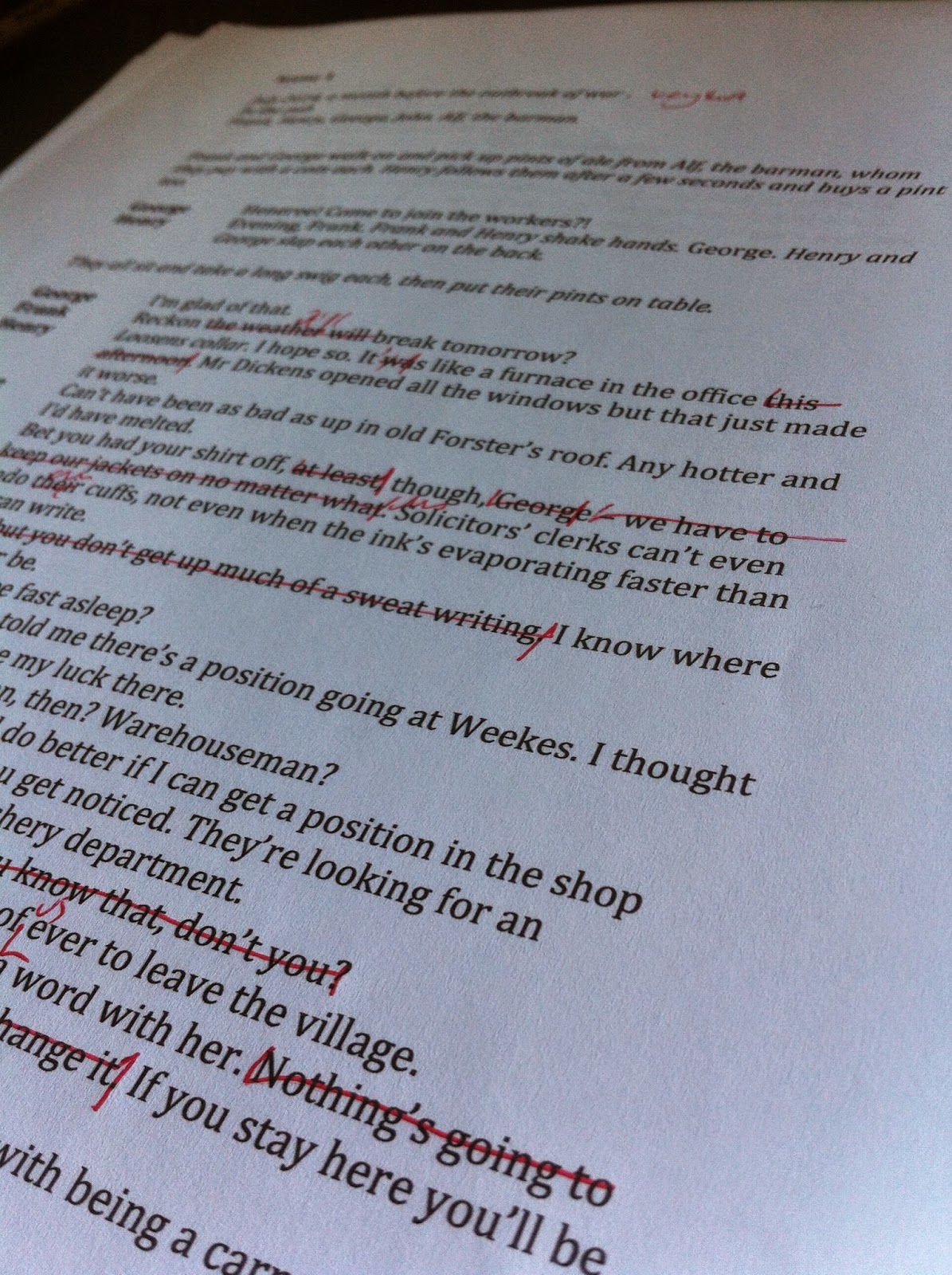
I procrastinated, of course. I wrote an outline, and we workshopped it. The workshop was great - some new ideas, some offers to research particular areas - but I was left with my outline and a lot of stage time to fill, a lot of dialogue to be written.

So I read Paxman's Great Britain's Great War, I ambled about the internet, I listened to archive recordings ...

Till I had one week in which to write sixteen three-minute scenes. 

So I sat down and I wrote. And I discovered that writing nothing but dialogue is liberating. All you have is people's voices - their words alone must tell us everything about who they are, their motivation, what they're hiding, what they fear, and what they all think about each other. So all you can do as their writer is put them in a space and hear what they say to each other. What a joy!

Of course, you also have to find ways of transmitting information, without it being in the least bit obvious. And you have to create a bit of tension in each scene so your audience doesn't fall asleep or start talking or texting. And you have to have some idea of the overall story, and keep it on track - it was terribly tempting to go off down some of those small side lanes, pursuing an individual character's particular passion ... but I dragged them back and I think we got there.

I finished the first draft yesterday and sent it off to a trusted friend and to the director. It's rough around the edges, but I think it's all right. And I really enjoyed writing it.

Tomorrow, I'm returning to a story I started ages ago. It has one character and no dialogue, but I've a feeling that may be about to change ...