Sunday, 22 February 2015

In it together: our community play about World War One in rural England

Henry (Nick Wray) and George (Charles Johnson)

It's Sunday afternoon, it's pouring, and I'm exhausted. But I'm elated too, because we've just put on three shows of our community play. We created a story about a village like ours during the First World War, and it's been a truly amazing experience.

Amazing because:

we pulled it off - we told a familiar story that held our audiences' attention from the first chords to the last song

we made our audiences laugh and weep

and then they rushed to tell us what a pleasure it had been

it was a truly collective endeavour - almost sixty of us came together to create our play

The Morris dancers (Colleen Thirkell, Molly Byford, Jan Batchelor and Sue Harrison)
and people gave up their winter evenings and weekends to learn lines, rehearse, make music, source fresh pheasants, rig up lights, bake cakes, find a hundred year old wheelchair ...

and we sold out three shows

and, and, and ...

I'm a bit overwhelmed by what we achieved, but fundamentally, what I'm going to remember for a long time is that this may have been just a play, but it was a play about something really serious, and everyone in the room - audience and players - knew it.

Len (Oliver Hulme), Lily (Melanie Byford), Isabella (Sarah Saxty), Frank (Steven James),  Henry, Rose (Annabel Hunt), Robert (Eric Parker), John (Charlie Crisp) and Hester (Ana Garcia)
A hundred years ago, people just like us were flung into four years of horror and fear that none were prepared for. When I started to write the script what interested me most was what happened between people. We all know the facts of the war, but what did it feel like to a young woman whose fiancé comes home on leave unable to speak about anything he's been through since they parted? How did a bereaved father deal with his son's friend who's refused to fight? What did a young man who has seen his mates killed one after the other have in his head when the old men in the pub clapped him on the shoulder for doing his duty?

What caught me unawares were the people who came up to me, separately, after the shows. One was a mother of soldiers who has set up a support group for veterans. Another was a retired Navy officer. The third, a serving Major in the Army. They each thanked us for showing what it's like to fight, and to return home with that experience inside you.

And then there were the villagers who felt that this story was part of them too, because the people in it were people just like us. I'm so glad we got it right.


(All photos are by Rowan Purkis.)


Friday, 20 February 2015

Reading Edward Thomas aloud to an unsuspecting audience


I have a terrible memory, and it's this more than anything else that means I'll never be an actor. How on earth do they learn all those lines?

It's not for lack of trying that I can't remember lines - tonight I'm reading Edward Thomas's poem, 'As the team's head-brass', between a couple of scenes in our community play, and I've really made a go of learning it by heart.

I read it aloud in bed. I marched across the fields reciting it. I pinned it up in the kitchen so I could keep checking it.

No good. I learned the first stanza, but moving onto the second, I could feel those first hard-won lines falling out of my head again. So I'll be reading from the page.

But my attempts at learning the poem by heart have paid off. I'm a lot more confident about reading it, of course, but I've also seen so much more in the poem that I just slid over when reading it to myself.

Reading aloud to an audience, especially an audience that most likely don't read poetry from choice, really makes you think hard about what every line means. I want everyone in the room to feel the beauty of the poem, to see Thomas's images, to hear his sadness at leaving England for the front, and his knowledge that this is a place he loves so much it's worth defending.

Reading it as I first heard it in my head, the audience would hear little of this - I'm a lazy reader, I've found, reading too fast. Even if I read a poem aloud to myself, I don't go over and over a line that puzzles me, I say it just well enough to move on, and then move on. You can't do this when you're reading to other people - you have to work it all out, word by word, line break by line break.

In one of my attempts to tell the poem aloud from memory, I completely missed out the second line, 'The lovers disappeared into the wood.' It's easy to miss: the poem still makes perfect sense without it. But by leaving it out, you lose a rare smile in Thomas's poetry - he's glad they're off to make love and that their urge for life is so strong and unaffected by the death around them. At the end of the poem, the lovers reappear in a matching single line, just as Thomas is saying farewell to the scene before him and perhaps to his own life, and this acknowledgement that life will carry on, whatever happens, both softens the sadness and makes it more poignant.

After the lovers return - and this is easy to miss too - Thomas says 'The horses started and for the last time/ I watched the clods crumble and topple over/After the ploughshare and the stumbling team.' Because Thomas's style appears so conversational, the words 'for the last time' don't jump out at you - but here they are, at the end of a line, three lines from the end of the poem, leading us into a description of the breaking of earth with metal. Thomas is a subtle poet. He doesn't need to tell us what he sees ahead - he prepares the land and sows the seed, and leaves it to us to understand in the silence that follows.


Friday, 28 November 2014

Rural grit: the power of writing in nature


This morning I read Grace Nichols' poem, 'Wings'. I don't think I've ever heard her called a nature poet - I'm guessing people most often define her as a Caribbean poet - but in so many of her poems the natural world is powerful force, driving her imagery. Here's the opening stanza of 'Wings':

Consigned to earth
we thought it fitting
to worship only
the sustenance of our roots,
so that when uprootment came
in its many guises
we moved around like
bereaving trees, constantly touching
our sawn-off places.
It's so tender, so painful, it stopped me in my tracks.

The natural world is often god-like in Nichols' poems, but though there's plenty of myth, and there are gods, it's too big, too complex to be merely a god. And it's also too small - a single red hibiscus flower, a clod of Sussex earth stuck to a shoe. We're irretrievably connected to the natural world, we're part of it.

When I was young I loved stories like Wuthering Heights where the vast empty moors, the wild storms, the sheer indifference of the land were just as much a part of the story as Catherine and Heathcliff. The landscape, the snow, the driving rain, were alive, were powerful players.

But though I loved these stories, I thought it wasn't cool to write like that any more. I thought that now we were modern, nature wasn't just wasn't gritty enough, real enough.

It silenced me as a writer for a long time, though I should have known better. I read JG Ballard after all - how didn't I notice that his triangle of land between the motorways in Concrete Island was fast reverting to the wild? Graham Greene, with his whiskey priest sweating through the banana plantations? Margaret Atwood? Cormac McCarthy? Robin Roberston? Seamus Heaney?

Nature writers? Maybe not. But writers who understand the power of nature, yes. And writers of power, most definitely. You really don't have to be urban to be cool.


Tuesday, 7 October 2014

A crash course in writing dialogue


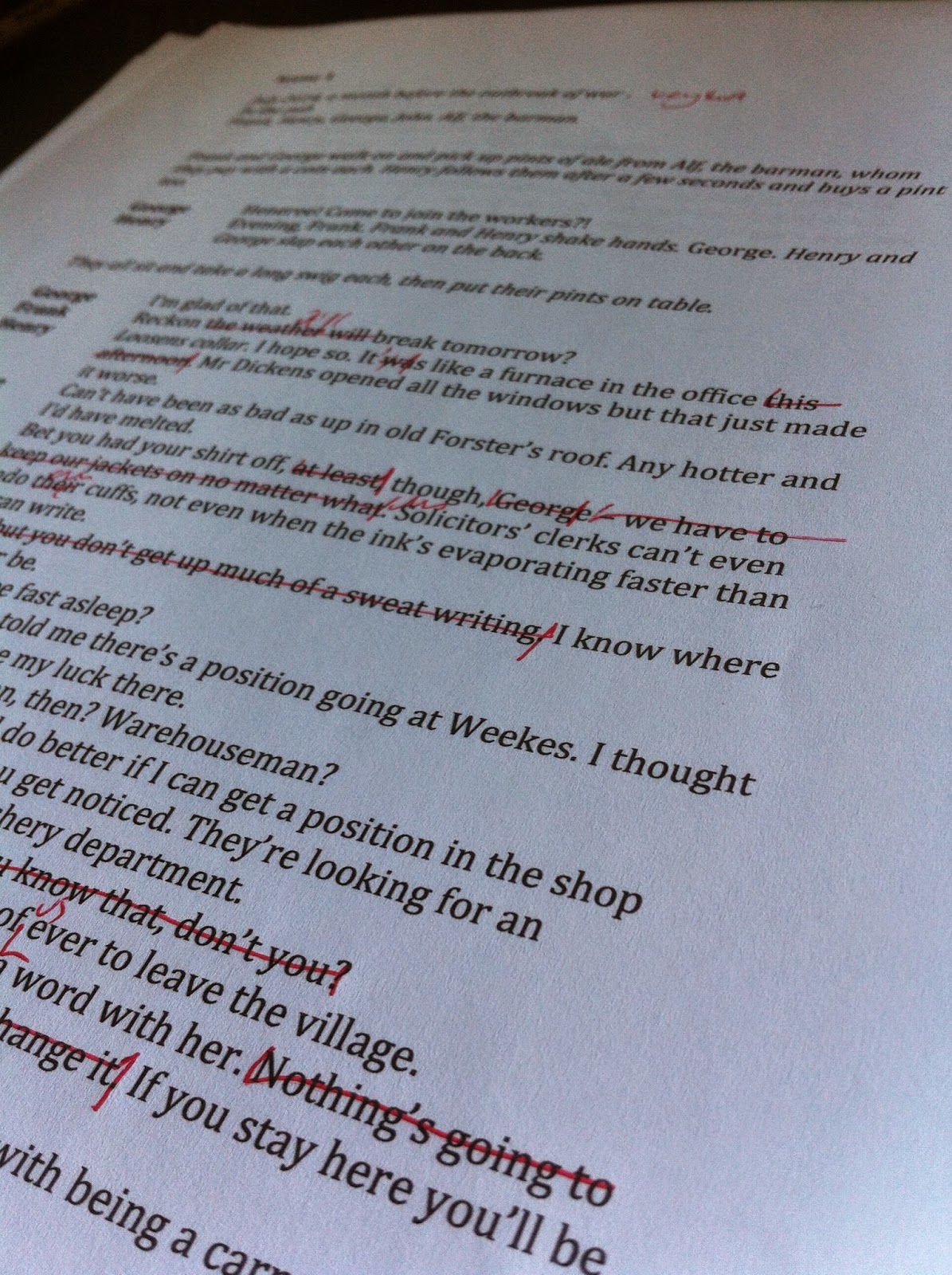
I don't write dialogue in my stories. Or at least sometimes I do, and then almost always I cut it out again. 

I know it's a handicap. I even went on a one-day dialogue writing course with the lovely Vicky Grut, and afterwards I did think I could write dialogue - a major step forward - but somehow I rarely get the urge, mid-story.

So I've really no idea why I said yes when a friend said, you write stories, don't you? How about writing our village play about the home front in the Great War?

I procrastinated, of course. I wrote an outline, and we workshopped it. The workshop was great - some new ideas, some offers to research particular areas - but I was left with my outline and a lot of stage time to fill, a lot of dialogue to be written.

So I read Paxman's Great Britain's Great War, I ambled about the internet, I listened to archive recordings ...

Till I had one week in which to write sixteen three-minute scenes. 

So I sat down and I wrote. And I discovered that writing nothing but dialogue is liberating. All you have is people's voices - their words alone must tell us everything about who they are, their motivation, what they're hiding, what they fear, and what they all think about each other. So all you can do as their writer is put them in a space and hear what they say to each other. What a joy!

Of course, you also have to find ways of transmitting information, without it being in the least bit obvious. And you have to create a bit of tension in each scene so your audience doesn't fall asleep or start talking or texting. And you have to have some idea of the overall story, and keep it on track - it was terribly tempting to go off down some of those small side lanes, pursuing an individual character's particular passion ... but I dragged them back and I think we got there.

I finished the first draft yesterday and sent it off to a trusted friend and to the director. It's rough around the edges, but I think it's all right. And I really enjoyed writing it.

Tomorrow, I'm returning to a story I started ages ago. It has one character and no dialogue, but I've a feeling that may be about to change ...

Monday, 15 September 2014

Cycling round Sweden without a plan

Photo (c) Ian Butler
Well, I've stopped dripping now, and my legs are beginning to feel normal again - we've been back two weeks from our holiday in Sweden, where we cycled north from Gothenburg to the very southernmost tip of Norway, then south again.

It was beautiful.

It was also quite stunningly wet. On re-reading my diary, I see that day 10 was the first on which we had no rain at all. And on many days before that we cycled through storms that put parts of the region under deep floodwater, and my lycra shorts in a similar state.

Oh, and my bike broke - a spoke snapped so the rear wheel buckled and the brake stopped working. And my gears did too, so the hills were really quite tough. My pannier came off too, but it's amazing what you can do with old guy ropes and duct tape.

Still, it was wonderful. Each morning all we had to do was eat, pack our tent up, pile everything onto the panniers, and set off to see what the day would bring.

We knew almost nothing about Sweden, and hadn't planned our route. We found a campsite on the map and cycled off to find it, and if we didn't like it, we carried on to find another.

We had our phones, but rarely found wifi, and sometimes had no signal. So we disconnected from home.

Aaaaaaaaaaahhhhhhhhhhhhh............

Photo (c) Ian ButlerIt was, of course, really hard work. We rode about 45 miles a day, sometimes much more, and our bikes were heavy. And what this meant, for me at least, was that I was exhausted - and this was the best thing of all.

I didn't think about anything. And I certainly didn't think about writing. I let my brain empty out at last, and it felt really, really good.

I've written a separate blog about the trip, with lots more pictures and details of the route and other stuff. It's called Hey hey! A cycling tour of Sweden, because my Swedish never got much beyond 'hey hey!' - as soon as I'd said hello, any Swedish person would break into English.

Do go to Sweden. Eat herring. Swim in a salty lake with crabs and jelly fish. Find amazing bronze age carvings. And let that pale blue air empty your mind.


All photos (c) Ian Butler

Tuesday, 29 July 2014

Looking for clues: five days in London, July 2014

I've just spent five glorious days in London seeing friends, visiting galleries and museums, watching plays and films, and walking and cycling all over the city.

I didn't especially plan what I saw, but here are some highlights - and an emerging theme.

At the Serpentine, Marina Abramovic's 152 Hours uses only her body and the bodies of the visitors to create a work of art.

She asks us to explore the work in silence, often eyes shut. We become highly aware of the people with whom we share the space, and of our own bodies. We have left everything else outside. We have only our bodies and our senses here.

We modify our behaviour - one man jigs and bows to the people around him when he arrives, but no one responds, and gradually he too becomes still.

I am strangely comforted to be tucked into a bed alongside maybe twenty others on identical beds - no one has tucked me in since I was a young child. But tucking in brings not only safety but an agreement to lie still. The bed isn't important, but the stranger's hand is.


At Dennis Severs' House in Spitalfields, there are no bodies except our own.

All we have are the objects left behind by a family of 18th century silk merchants and their descendants. They have, it seems, only just left - we see half drunk cups of tea, an overturned chair, hear a ticking clock.

How much of these people is held in the physical space they once inhabited?


Jennifer Haley's play, The Nether has just opened at the Royal Court (this is their image) and it's uncomfortable to watch. The scenes alternate between two locations. The first is an interrogation room - bleak, featureless and grey - where a young officer questions two men about their involvement in an online world. In this world visitors can have virtual experiences that are as rich and real feeling as reality.

The other location is that virtual world, beautiful and carefully detailed, where visitors may indulge their paedophilia without fear of exposure. As watchers, we feel we are taking part in this world too - and feel compromised because we have chosen to visit a place where terrible things happen.

But we also know that this is a created world, a world that only exists in the mind. And for me as a writer, created worlds are what I make. I defend my right to create worlds as strange and uncomfortable as I want. Is there a boundary over which we should not step? What happens when the virtual experiences we create, and live, become as important to our identity as our experiences in the physical world?

Coda
I'm sure there are intellectual giants who can immerse themselves in such wonderful stuff from dawn to dusk, day after day. Lest anyone thinks this is the kind of person I am, here are some other highlights:


lashings of cake (thank you Zoe for introducing me to Princi and their magnificent and enormous slices after a splendid visit to the National Portrait Gallery)


the joy and freedom of a bike (still a pleasure when it's 29 degrees in the shade because it's way better than a bus or tube)


regular views of beautiful buildings (my very lovely friends lent me their flat and this is what I saw each day as I left and came home - thank you, it was wonderful)

and deep breaths of fresh air and the scent of hot plants in the Chelsea Physic Garden. aaaaaaaahhhhh!


Thursday, 12 June 2014

Words come when you're not looking

As some of you will know, I've just started spending every Wednesday writing.

It's remarkably productive, because in the six days between Writing Wednesdays (they're so important that they absolutely deserve capitals), I think about the story I'll be writing the following week. Wednesday morning, I'm ready to get going as soon as I've drunk some coffee.

The kitchen is really clean on Thursdays because wiping down drawer fronts, washing up all the cutlery or scrubbing the fridge helps me to think about the knotty problem I've just come up against in the story I'm writing.

I'm getting fitter too. Yesterday I had a revelation about the end of a story while cycling up a particularly vicious hill. I put it down to lack of oxygen in my brain making it see strange connections.

Doing something that's not writing, but while you're writing, is the best way to see a new angle, hear a resonance, or smell a character who's been hiding in the undergrowth.

And here's another thing I've found out.

Last week I finished a story I've been writing since January. Then I looked at another story that I completed a while ago and realised that I needed to cut the first half of the first sentence. I went back to the first story and found that it needed a few teaks that I hadn't been able to see while embedded in it. I made the changes and sent both stories out - the first in ages. Reading another story helped me to step back from the one I was writing. By coincidence, Adam Marek, whose stories I admire hugely, blogged this week about working on two stories at once and how it helps him to see each more clearly - take a look at how it was for him.