Friday, 30 March 2012

The Thing in the Gap-Stone Stile, Alice Oswald


I've been reading Alice Oswald's The Thing in the Gap-Stone Stile for a few months now - it's so richly written that I put it down for weeks between each poem.

Last night I sat up till midnight to finish it, going to sea with 'The Three Wise Men of Gotham Who Set Out to Catch the Moon in a Net', the surprising narrative poem which rounds off the collection.

Surprising, because narrative isn't what drives most of the poems here - though people move (or lie awake) through many of them, the poems are observations, close watchings: of a wood coming to life in spring, the moon's light on the sea, a neighbour on the other side of a party wall.

I bought the collection because I opened it in a bookshop and loved the first two lines of the first poem, 'Pruning in Frost':

Last night, without a sound,
a ghost of a world lay down on a world,


The final poem has a wonderful opening too, returning to the motif of moonlight on the sea, but this time blending the prosaic (signalling the story to come) and the poetic:

It was a monday night. The moon was up
and throwing golden elvers on the water.

This final poem swept me up in its rhythms - Oswald creates a strange, magical world, never whimsical, completely rooted in the physical sensation of being at sea at night, and transports us utterly.

Not every poem in the collection worked for me, but it's been a joyful experience to discover Oswald. I'll be back for more.


Wednesday, 28 March 2012

ReAuthoring

Last weekend I took part in something it's hard to put a name to. I heard someone call it a 'creative retreat', and it was that - we retreated, and we created. But it was much more too.

None of us knew what to expect from the  ReAuthoring weekend, and I'm still slightly bemused, to be honest. I had a great time, played some amazing games of keepy-uppy,  emoted with a chair, learned to take applause without doing that half smile that says 'I know this isn't what English people do, I'm as embarrassed as you are' and created three short performances based on one of my short stories. Boy was that difficult.

I've no idea what they were like to watch - the first was fairly excruciating to perform, the last quite fun. I think they conveyed something of the story they were based on - but who knows? I'm building up courage to ask to see the videos.

Performing a version of my work may not change what I write, but it will, I'm sure, make me more aware of who's reading it - or watching it - and what each word might convey to them.

And I'm definitely more comfortable with the idea of standing up in front of people and giving my work to them. It's OK. I'll never be an actor, but I can learn from performers. Breathe. Be present in yourself. Sounds like hokum,  but it works.

If I'm brave enough, and the videos don't make me despair, I'll pull apart another of my stories and create a new performance because the ReAuthoring team is busy setting up opportunities for people to come and see our work. It's scary and exciting, and the only way I can imagine doing it is alongside the other five writers who clowned, shared generously, and took my breath away with their work.

Thanks, ReAuthoring!


Saturday, 17 March 2012

Homesharers in The Guardian


I don't usually write about my paid/professional/non-fiction work here, but today I'm making an exception because if you click here:


you'll see a piece by me and lovely photographer Mike Pinches in The Guardian's Saturday magazine.

This is triply exciting, because ...

... it just is, if you're a freelance writer

... the piece was terribly hard to pull together (though I hope it doesn't show)

... we thoroughly enjoyed meeting our interviewees and it's a real pleasure to see them and their stories here on the page.

Homesharing's a brilliant, simple idea. An organisation - it could be an local Age UK, a council, a church, or a social enterprise - brings together a person with a spare room who needs a little light support at home, with another person who can offer that support and who needs somewhere affordable to live. Each pays a small monthly fee - far lower than they would pay to a care agency or in rent. The homesharer commits to providing around ten hours' support a week, which they can fit around work or study. The householder has someone to help with daily life, and who sleeps in the house at night. The organisation provides support and security in return for the fees.

So far, so sensible. But what makes homesharing so interesting is the relationships that develop between householders and homesharers, and these are at the core of what makes a successful homeshare so powerful.

It's also what drew us to meet homesharers - though the nuts and bolts matter, it was the relationships which fascinated us. They ranged from courteous and slightly formal, to intimate and full of deep affection, and while matches which work well are the holy grail of homesharing, it became clear that common values and respect go a long way to making for a happy household.

We began work on our homesharing piece last March, when we met Mrs Haar and Joanna. As soon as we met them we knew this would be a great subject - their relationship was complex, and based on an instinctive understanding of hidden boundaries, and we wanted to meet more people in similar situations.

The Guardian liked our pitch and asked for five more interviews. We did another in London, with Marjory and Heather - two people who were a joy to spend a day with - and then hit the buffers. We'd begun the piece at exactly the wrong time. These aren't easy programmes to run because they always involve taking time to get to know the people involved. And time costs money. Government cuts and the pressures on anyone involved in the voluntary sector meant that homeshare schemes were closing faster than we could meet the homesharers they'd brought together.

The schemes in Oxford and West Sussex folded one after the other. Somerset was making no new matches, and nor was Bristol. East Sussex, bucking the trend, was setting up a new scheme, but were clearly uneasy about letting me talk to their new homesharers. Then Age UK Carlisle and Eden put its hand up - it was underway too with a new scheme, and had a match who'd love to talk to us. Off we went to Penrith in the September heatwave to meet Maureen, Ken and Viktorija.

They were great interviewees, but that was it. No more schemes. We could have found more people in London, thanks to the enormously helpful people at Share and Care (who support Marjory and Heather), and Crossroads Care Central and North London (through whom we met Mrs Haar and Joanna), but The Guardian wanted a spread of people across the UK, and there just weren't any more homeshare schemes.

We did think about going to Paris, which has a hugely successful scheme called Ensemble2Generations but The Guardian wasn't keen. It began to look as though we'd have to abandon our piece, despite the great pictures Mike had taken, and the screeds of interview transcriptions in my pc.

At this point, all I can say is what a splendid scheme CSV is. Not only because their volunteers do amazing work throughout the UK, living in with people with considerable need for support and care (unlike the homesharers, volunteers may provide personal care and usually work around 35 hours), but also because CSV really pulled out all the stops to set us up with three more interviews. Thanks to them we set off for Dunfermline, Milton Keynes and Birmingham in quick succession, and met some amazing people living difficult but full lives with the help of their volunteers, and often discovering lasting friendships along the way.

So hurrah for all the people we met, and all the people who helped us to meet them!

Age UK Carlisle and Eden
Crossroads Care Central and North London
Share and Care
Homeshare International - the umbrella body for homeshare schemes worldwide, with a database of UK schemes
Shared Lives Plus - the UK umbrella body for homeshare and other similar schemes
CSV

Tuesday, 28 February 2012

Where I read

At the weekend someone asked me when I read short stories - they felt that a short story wasn't satisfying enough when they sat down in an armchair and pulled out a book, so they never read them. I thought about it and here's my answer:

I leave books of short stories and poetry around, so that if I have an urge, or ten minutes spare, I can pick one up and read. I can then carry the poem or story with me in my head.

This seems to me to be the best way of reading such intense and juicy things as poems and short stories. I need space in my head after reading one so that it can soak in, and so that I can think about it. It takes a truly stunning story or poem to stay fresh in my mind if I read another one straight after it.

So here's where I read:


in bed

in the kitchen
on the blue sofa


on my way out of the living room


in my office, when I should be working


no comment


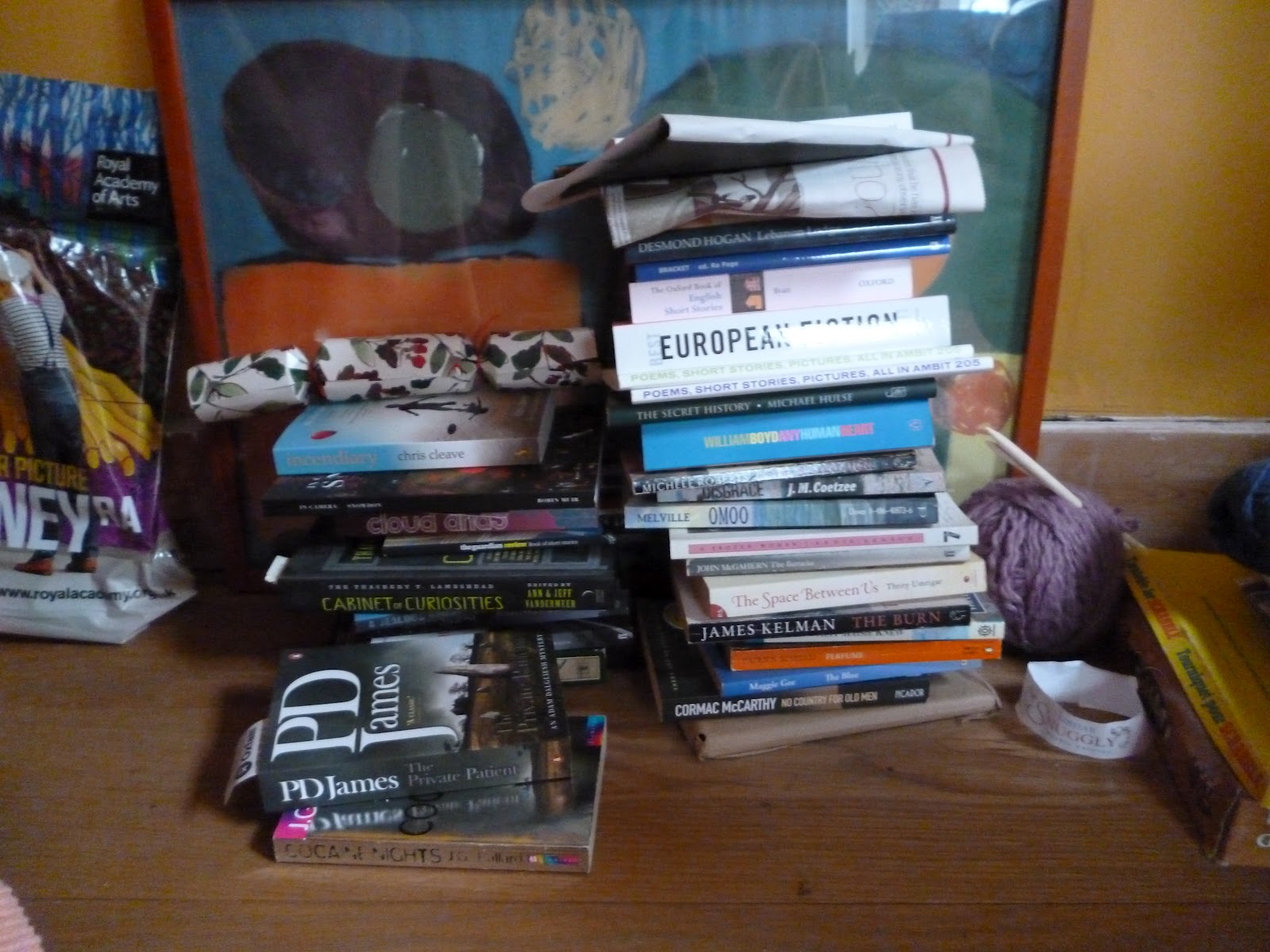
in the living room (this is The Pile of books waiting to be read)

 back in my office


and there's always a book in my bag, just in case there's a nice little gap when I'm out.

Wednesday, 15 February 2012

A new look for ... February

You've no idea how long it took me to create this new look for my blog. The old one was fine and rather cosy with its jolly picture and bright colours. It did look a bit dated though so I set myself the task this week of creating something a bit more grown up.

Given the title of my blog it seemed obvious that I should take a photo for the header lying on the floor below our wall of bookshelves.


It took ages to get the shelf lined up more or less straight in the picture. And even longer to work out how to stop the template creating a mad tiled effect all over the top of the page.

I also had to resist the temptation to start reading all the books I'd pulled out so that they were visible from below.

All in all it was a pretty pleasant way to spend a wet afternoon. Back to work today though.


Friday, 10 February 2012

Hands


I've just finished a story in which hands are important. I'm superstitious about my stories so won't reveal more until (unless) it's published. Sorry about that.

To celebrate, I went into Tunbridge Wells to see Snowdon's In Camera exhibition. It's a collection of his portraits of artists, and what struck me most was the state of the sculptors' hands. I'm quite jealous.

That's my right hand above, squashed into my scanner. If you look closely, you can see two small burns where I caught myself while loading the woodburner.Otherwise, it's pretty much just a hand that's been around for a few years. Writing doesn't scar your hands.

Why am I jealous?


Because the artists gained their scars by pursuing their work unflinchingly. That's how I'd like always to work but if I'm honest, sometimes I do flinch. I always regret it - a story where I've flinched is never as good as one where I've faced up to the sticky messy insides of what made me write it in the first place.


So, from now on, no flinching, no matter what it does to my metaphorical hands.

Tuesday, 7 February 2012

Photographers but no photos


I'm definitely an amateur photographer, and not a very good one at that. I use a point and click camera, and can never remember the important things like depth of focus, so my photos are pretty much the result of luck.

Because I sometimes get to work with photographers, I know that a good photo is almost never down to luck. Though being in the right place at the right time helps, you also need to have a great eye, amazing reflexes if things are on the move, and lots of technical knowledge. Good knees are handy too - they all seem to spend a lot of time crawling about on the ground.

It's not about the camera - a decent photographer will take a fabulous shot with my camera phone and I'll take an utterly unmemorable one with the very best equipment.

I tremble whenever an ill-advised editor hands me a camera and asks me to take the photos myself - last time that happened was at a conference, and I was expected to take photos of people chatting over coffee, but the only lens they gave me on the huge and complicated camera was a vast telephoto so I spent the coffee breaks pinned against the back wall of the hotel trying to get far enough away from my targets.

Anyway, I thought I'd share the websites of four photographers I've worked with and whose work I really like. Mike Pinches and I have done lots of work for Sense (the deafblind charity) together, and have just finished a feature which I'll be shouting about here in a few weeks, I hope. He's quiet and calm, perfect attributes in a photographer, I'd say. Just take a look at his portraits.

Mike's assistant on our photo-feature was Mark Cocksedge. He's also just assisted at the The Blue Oblique shoot of David Hockney for the RA - and his own work's great too. I love his Sunday league football refs especially.

Steffi Pusch is a quite different kind of photographer. Where Mike and Mark's work is clean and bright, Steffi likes to muddy the waters. Her shots are moody, full of hidden elements, emotional. She often works with a pinhole camera, making complex images. She and I have been collaborating on an illustrated version of my story The Swimmer which The Old Stile Press is bringing out this year. I love her portraits, but perhaps the photos of hers I love most are her series, Soul Flowers.

Roelof Bakker came to me via The Swimmer too, which he read and liked, so he asked me to write a story to go with one of his photos - a great treat. He has some fabulous photos of Dennis Severs House on his site, which reminds me that I want to go there this year.

It seems a bit strange, talking about photographers, but showing none of their pictures.But there's a reason for that - their photos are their work, and they're all copyright and I wouldn't dream of infringing it. So you'll just have to go to their websites, I'm afraid. Sorry.